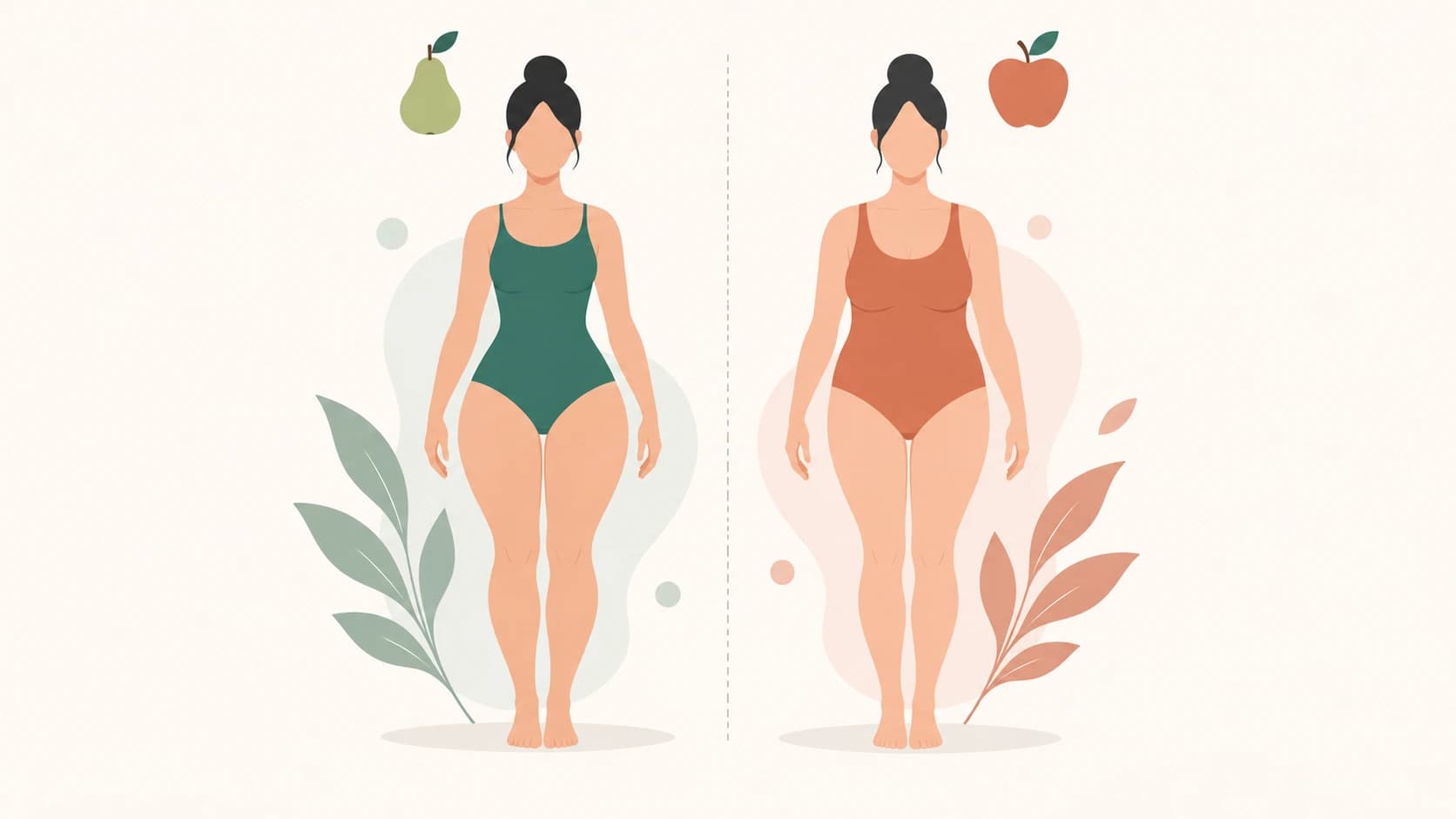
Pear and apple sit at opposite ends of the same comparison, which makes them one of the easier pairs to tell apart once you know what's actually being measured — yet they still get searched together often, usually by people checking which side of the bust-to-hip line they land on rather than confusing the two outright. Pear means hips outsize the bust; apple means the reverse. There's no shared middle ground between them — that space belongs to rectangle instead, which is why understanding all three together (not just pear and apple) is the fastest way to place your own measurements correctly. Part of why these two get searched as a pair, rather than each in isolation, is that both are commonly discussed in terms of "problem areas" in older style content — pear for hips, apple for the midsection — which frames them as a matched set even though the underlying measurement rule treats them as simple opposites. This guide covers the exact rule, why people still check both before settling on one, and how to confirm yours in under a minute.
Pear
A pear shape (also called triangle) has hips noticeably wider than the bust, with a defined waist in between. It is one of the most common female body shapes.
Full Pear style guideApple
An apple shape has a bust that measures larger than the hips, with weight often carried around the midsection rather than at the hips or thighs.
Full Apple style guideNot sure which of the two you are?
Enter your measurements and the free calculator applies these exact rules for an instant result.
The measurement that actually separates them
Pear requires your hips to measure more than about 5% larger than your bust. Apple requires the opposite: your bust measuring more than about 5% larger than your hips. Because these two rules point in opposite directions, you cannot qualify for both — but you can qualify for neither, which is what happens when bust and hips are within that 5% margin of each other (that combination is rectangle, not pear or apple). The waist doesn't factor into either classification directly; it's the bust-to-hip comparison alone that decides which of the two you are, if either. This is a meaningfully different rule from hourglass or rectangle, both of which do care about the waist — pear and apple are purely a two-number comparison, which is part of why they're quicker to check than the other shapes once you know which two numbers matter.
How to tell which one you are
Why people still check both before deciding
Frequently Asked Questions
Can someone be both pear and apple?
No — the two rules are mutually exclusive by definition. Pear requires hips to exceed bust by more than 5%; apple requires the opposite. A measurement set can satisfy at most one of these two rules, or neither (which makes it rectangle).
If my bust and hips are close, am I pear or apple?
Neither — that combination is classified as rectangle. Pear and apple both require a real gap (more than about 5%) between bust and hips, in opposite directions. Bust and hips being close together doesn't qualify for either.
Which is more common, pear or apple?
Pear is generally cited as more common than apple. Widely-referenced sizing research (SizeUSA, 2005) put pear at around 20% of women and apple at around 14%, though exact figures vary by population and measurement method and should be read as general indicators rather than universal rates.
Does carrying weight at the midsection always mean apple?
Not necessarily. Apple is decided specifically by the bust measuring larger than the hips — not by how the midsection feels or looks. Someone can carry some weight at the waist while still having a bust and hips close enough in measurement to classify as rectangle.
Can pregnancy or weight change shift someone from pear to apple?
Yes, in principle — since both classifications depend on the current bust-to-hip relationship, significant changes to either measurement (through weight change, pregnancy, or age) can shift the ratio enough to move someone from one classification to the other, or into rectangle. Body shape reflects current proportions, not a fixed, permanent label.
Do pear and apple get styled in opposite ways?
In a sense, yes — pear styling generally aims to add visual weight above the waist to balance fuller hips, while apple styling aims to draw the eye downward and away from the midsection. See each shape's full guide for the complete styling breakdown, since the specific recommendations go well beyond a simple "opposite" rule.
How close to the 5% threshold is considered borderline?
There's no separate "borderline" category in the classification itself — the rule applies at exactly 5%, one way or the other. Practically speaking, if your calculated percentage difference is within a point or two of 5% either way, it's worth double-checking your measurements, since a small measuring error is more likely to affect the result than it would if your numbers were clearly well above or below the threshold.
Pear and apple are opposite answers to the same question: which is bigger, your bust or your hips? If neither is clearly bigger, you're likely rectangle instead of either. Enter your measurements into the free calculator to get a precise answer rather than guessing from how your midsection or hips look in the mirror, and check the full style guide for whichever shape you land on to see the complete styling breakdown. If your result ever changes after a re-measurement, that's expected rather than a sign of an earlier mistake — proportions shift over time, and the calculator will always reflect your current numbers rather than a past result.
Ready to find out for certain?
Try our free calculator — enter measurements for an instant result. 100% private, nothing stored.
Use the Free Calculator