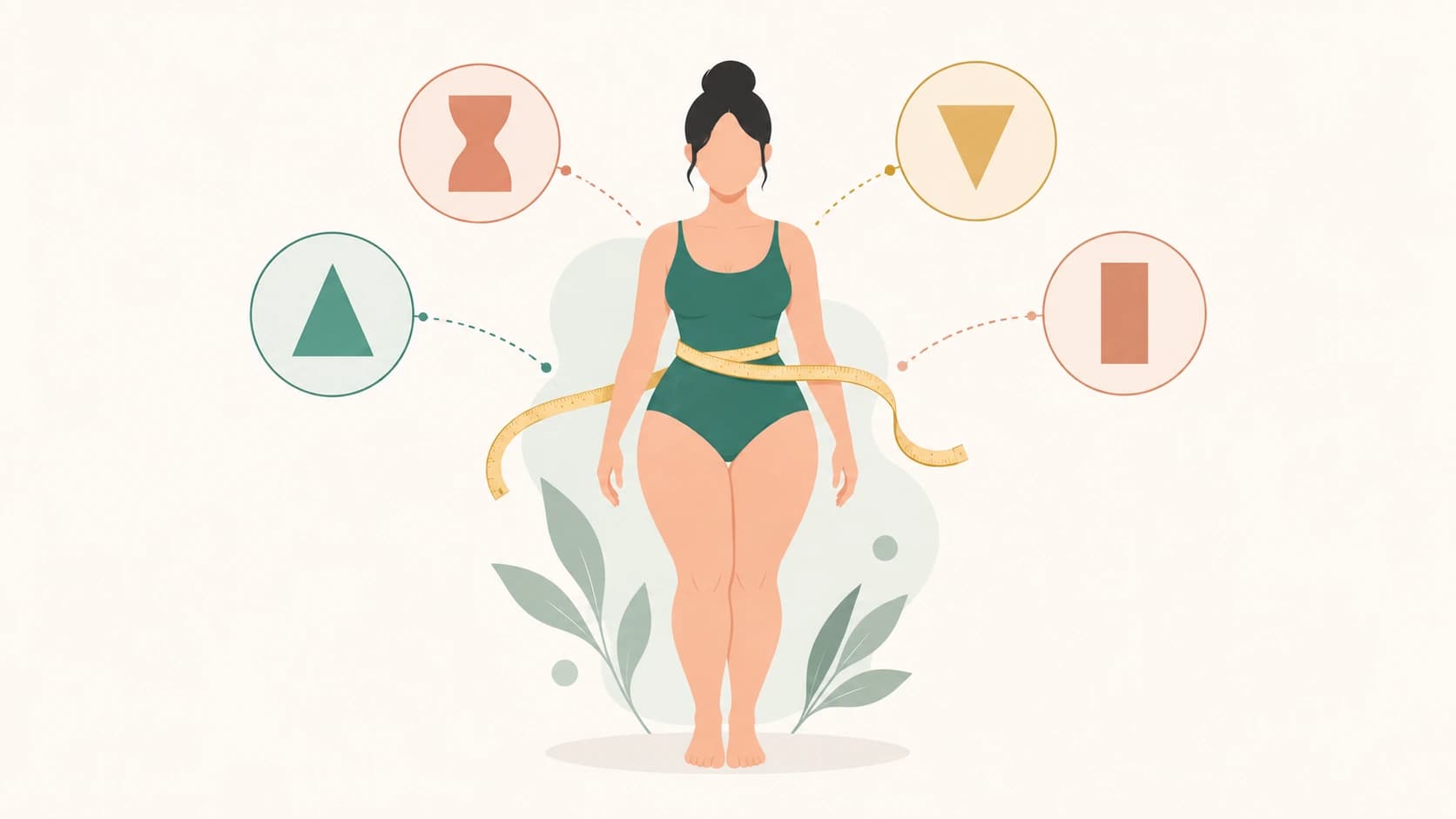
Trying to figure out your body shape by looking in a mirror or comparing yourself to photos is unreliable — lighting, posture, camera angle, and clothing all distort how proportions read visually. Body shape is decided by an objective comparison between three measurements: bust or chest, waist, and hips. If you take those three numbers accurately and compare them the right way, there's no ambiguity left. This guide walks through exactly how to do that, and the specific mistakes that most often give people a wrong or inconsistent result.
Ready to put this into practice?
Try the free body type calculator — instant results, nothing stored.
The three measurements that actually decide it
For women, body shape is classified from bust, waist, and hips; for men, from chest, waist, and hips. Nothing else — not height, weight, dress size, or how you feel your proportions look — factors into the classification. Measure bust or chest at the fullest point, waist at the narrowest point (usually just above the navel), and hips at their widest point, all with a soft measuring tape kept level and snug but not tight. Write all three numbers down before comparing them, since the classification depends on how they relate to each other, not on any single number viewed alone.
Common mistakes that give a wrong result
The most frequent error is measuring the waist at the belt line (hip bone height) instead of the natural waist (the narrowest point of the torso), which artificially narrows the waist-to-hip gap and can push a pear result toward hourglass, or vice versa. Measuring over thick clothing, letting the tape sag at the back, or pulling it too tight are close behind — each distorts one measurement relative to the other two, which is exactly what the classification depends on. Rounding measurements too aggressively can also matter near a threshold: the difference between hourglass and rectangle can come down to a couple of centimetres in the waist, so a measurement rounded generously in one direction can flip the result.
Why mirror-guessing doesn't work
Visual self-assessment fails for a specific reason: humans are bad at judging ratios between three separate points on their own body, especially from angles you can actually see yourself at. A slightly looser top can make a defined waist look wider than it is; standing at an angle can make hips look narrower relative to the bust than a straight-on measurement would show. None of this is a personal failing — it's simply that proportion comparison needs an objective measuring tool, not a visual impression, which is exactly why the classification is built entirely from tape-measure numbers rather than a self-rating scale.
Getting a reliable result
Once you have accurate bust or chest, waist, and hip numbers, entering them into the free calculator applies the exact same percentage-based rules every time — no interpretation, no guessing which category you're closer to. If your numbers land close to a threshold (for example, a hip measurement just barely over 5% larger than your bust), it's worth re-measuring once to confirm, since being within a centimetre of a boundary is the most common reason for an unexpected result.
Measuring with a second person, if possible
Self-measuring is accurate for most people, but the hip and back-of-waist measurements are the two most prone to error when done alone, since you're reaching around your own body and can't always see whether the tape is level at the back. If you have someone available to help, even briefly, it removes most of that error: they can confirm the tape sits level all the way around and isn't twisted or sagging, which is difficult to check in a mirror by yourself. If you're measuring solo, a full-length mirror positioned to show your side profile, combined with a second check in a different mirror angle, is the next best option.
What to do if your result surprises you
If your calculator result doesn't match what you expected, the most productive first step is to re-measure rather than to distrust the classification. Check specifically for the two most common errors: waist measured at the belt line instead of the true narrowest point, and hips measured slightly above or below the actual widest point. If a careful re-measurement gives the same result twice, treat it as accurate — a surprising result is far more often correct-but-unexpected than it is a calculation error, since the rule is applied consistently and doesn't involve subjective judgment once the three numbers are entered.
Frequently Asked Questions
What is the most reliable way to know my body shape?
Measure your bust or chest, waist, and hips accurately with a soft tape measure, then compare the three using an objective, ratio-based rule — which is exactly what the free calculator does. Visual self-assessment is unreliable because humans struggle to judge proportion ratios on their own body.
Can I tell my body shape from a photo?
It's less reliable than direct measurement. Camera angle, posture, lighting, and clothing all distort how bust, waist, and hip proportions appear in a photo. A tape measure gives an objective number; a photo gives an impression that can be misleading.
Why did I get a different result when I re-measured?
This usually means your first measurement had an error — most often the waist measured at the wrong point (belt line instead of the natural waist), tape pulled too tight or too loose, or measuring over thick clothing. Re-measure carefully following the exact landmark instructions and the result should be consistent.
Do I need any special equipment to find my body shape?
Just a soft, flexible measuring tape (the kind used for sewing, not a rigid metal tape) and a mirror to check the tape stays level. No scale, calipers, or special equipment is needed for shape classification.
Should I trust my body shape result if it feels wrong?
Yes, provided you measured carefully. The classification is a fixed rule applied to your exact numbers — it has no room for subjective interpretation once the measurements are entered. A result that feels surprising is usually correct; re-measuring to confirm is more useful than assuming the tool made an error.
Is it better to measure in the morning or evening?
It matters less than measurement technique does, but for consistency, pick one time of day if you plan to re-measure later to track changes — bust, waist, and hip measurements can shift very slightly with hydration and food intake throughout the day, though rarely enough to change a classification on their own.
Your body shape is not a matter of opinion or visual impression — it's a direct comparison between three measurements, decided the same way every time. Take your bust or chest, waist, and hip measurements carefully, ideally with a second person's help if you can, then let the free calculator apply the exact rule instantly.
Ready to try it yourself?
Use the free body type calculator — 100% private, nothing stored.
Use Body type calculator