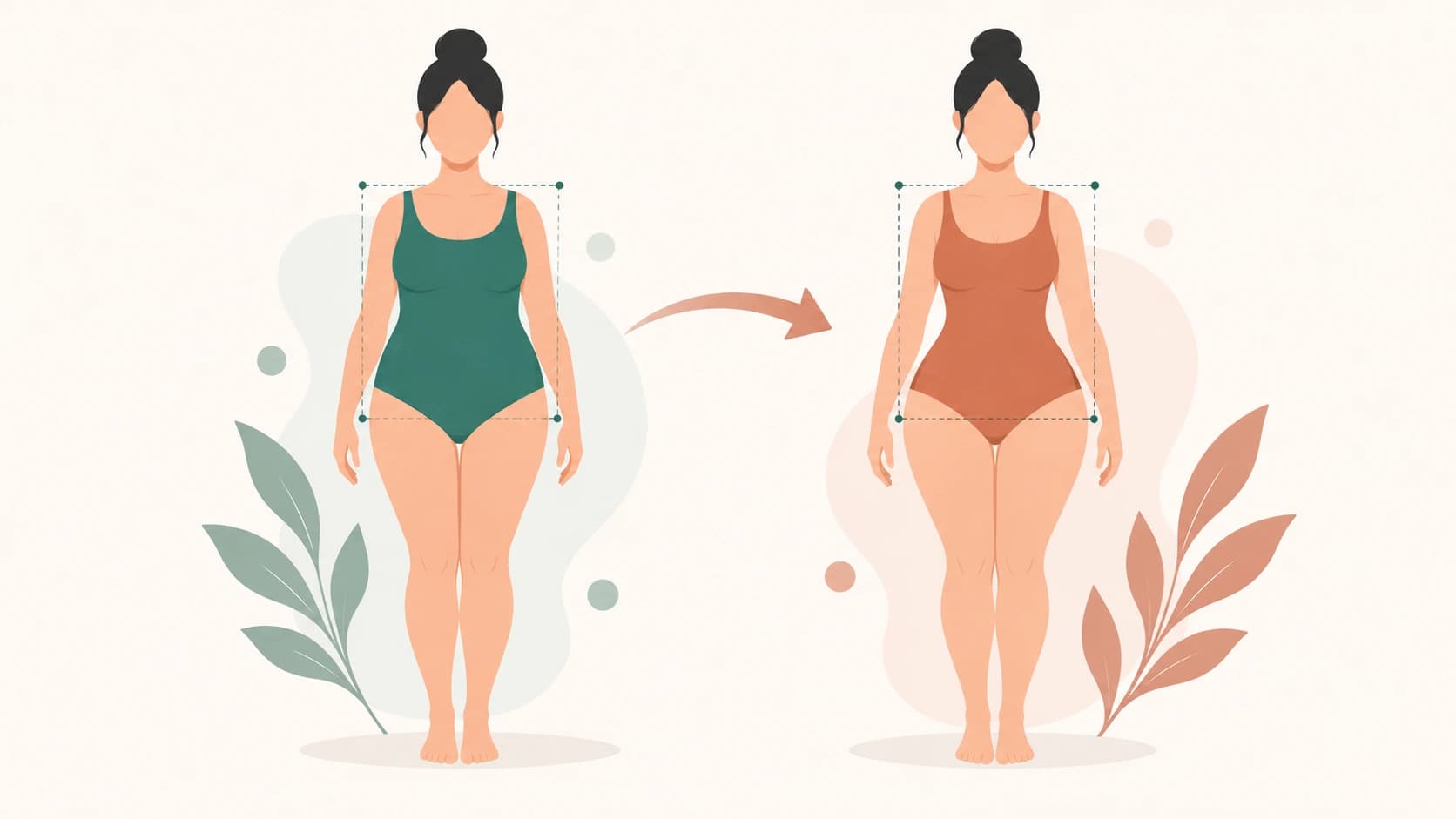
Unlike bone-structure systems such as Kibbe, the measurement-based body shapes (hourglass, pear, apple, rectangle, and their male equivalents) are not fixed for life. Because they're calculated from the current ratio between bust or chest, waist, and hips, anything that changes those measurements — even temporarily — can shift which category you fall into. This guide covers the main factors that actually move the ratio, and roughly how much change tends to be needed before a classification shifts.
Ready to put this into practice?
Try the free body type calculator — instant results, nothing stored.
Weight change
Weight gain or loss rarely distributes evenly across bust, waist, and hips — most people carry and lose weight from certain areas faster than others, which is exactly what shifts the ratio between them. Someone who gains weight primarily at the waist, for example, can move from hourglass toward rectangle or apple as the waist-to-bust-hip-average ratio increases, even if their bust and hips barely change. The reverse applies to weight loss: losing weight disproportionately from the hips can shift a pear shape toward rectangle. There's no universal direction — it depends entirely on where an individual's body tends to store or release weight first.
Pregnancy and postpartum changes
Pregnancy changes waist measurement substantially and temporarily, which can shift someone toward apple or rectangle during pregnancy regardless of their pre-pregnancy shape. Postpartum, measurements typically shift again as the body changes over the following months, and hip measurement can also change permanently for some people due to the pelvis widening during childbirth. Because of how much these changes fluctuate in a short window, re-checking body shape well after the postpartum period settles gives a more stable, representative result than checking during pregnancy or in the first few weeks after.
Age and hormonal shifts
Body fat distribution tends to shift with age and hormonal changes — most notably, many women experience a redistribution toward the midsection around and after menopause, which can move someone from hourglass or pear toward apple or rectangle over that period, independent of overall weight change. This is a well-documented pattern in body composition research, not a measurement error — it reflects genuine physiological change in where fat is stored, not where it was stored earlier in life.
Muscle gain and training
Resistance training changes shape by building muscle in specific areas rather than by changing fat distribution. Building shoulder and chest muscle can shift a rectangle build toward inverted triangle (checked against both waist and hips); building glute and hip muscle can shift someone toward pear by increasing the hip measurement relative to the bust or chest. Because muscle-driven shifts tend to be more gradual and intentional than weight-driven ones, they're often the most predictable of the factors covered here — the change tracks closely with the specific area being trained.
What tends to stay stable
Bone structure itself — the width of your shoulders and hips at the skeletal level, not the soft tissue around them — is the one factor that doesn't meaningfully change after skeletal maturity, outside of the pelvic widening that can occur with childbirth mentioned above. This is a useful distinction from systems like Kibbe, which classify by bone structure specifically and are designed to stay stable across weight and age changes for that reason. The measurement-based shapes covered here classify soft-tissue proportions (bust or chest, waist, hips), which is exactly why they're more responsive to weight, pregnancy, age, and training than a bone-structure system is.
How often it makes sense to re-check
There's no fixed schedule that applies to everyone, since the rate of change depends entirely on what's driving it — a stable weight and routine can mean years without a shift, while an active weight-loss program, a new training block, or a life stage like pregnancy or menopause can change the ratio within months. A practical rule of thumb: re-check after any change of roughly 10 pounds (4-5kg) or more, after starting or significantly changing a resistance training routine, during any major life stage transition, or simply whenever your clothes start fitting differently than your last known shape would predict.
Frequently Asked Questions
How much does a measurement need to change to shift my body shape?
It depends on how close your current measurements are to a threshold. Since most classifications hinge on roughly a 5% difference between two measurements, someone already close to that margin can shift categories with a smaller change than someone whose measurements sit well inside one category.
Does losing weight always move you toward the same shape?
No. Weight loss affects whichever areas lose fat first for that individual, which varies by person. There's no universal shape that weight loss moves everyone toward — it depends entirely on where the loss occurs relative to your other two measurements.
Should I re-check my body shape periodically?
It's a reasonable idea if your weight, training routine, or life stage has changed meaningfully since you last checked — pregnancy, significant weight change, new resistance training, or a hormonal transition like menopause are all good triggers to re-measure and re-run the calculator.
Is it normal for body shape to change more than once in a lifetime?
Yes. Since the classification reflects current proportions rather than a fixed trait, it's normal for someone's result to shift more than once across different life stages, weight changes, or training phases. This is expected, not unusual.
Does body shape change the same way for men and women?
The same general factors apply — weight change, age, and training all affect the ratio for both — but the specific classifications differ. Men's shapes (inverted triangle, triangle, oval, rectangle) respond most to chest and shoulder training and waist-area weight change, while women's shapes (hourglass, pear, apple, rectangle) respond most to bust, waist, and hip changes from weight, pregnancy, and hormonal shifts.
If my body shape changes, does my Kibbe type change too?
No — this is one of the key differences between the two systems. Kibbe classifies by bone structure, which stays stable through weight, age, and most training changes, while the measurement-based shapes covered here classify soft-tissue proportions, which are far more responsive to those same changes.
Body shape is a snapshot of your current measurements, not a permanent label — weight change, pregnancy, age, and muscle gain can all shift it in either direction. If it's been a while since you last measured, or your body has changed recently, re-run your numbers through the free calculator for an up-to-date result.
Ready to try it yourself?
Use the free body type calculator — 100% private, nothing stored.
Use Body type calculator